
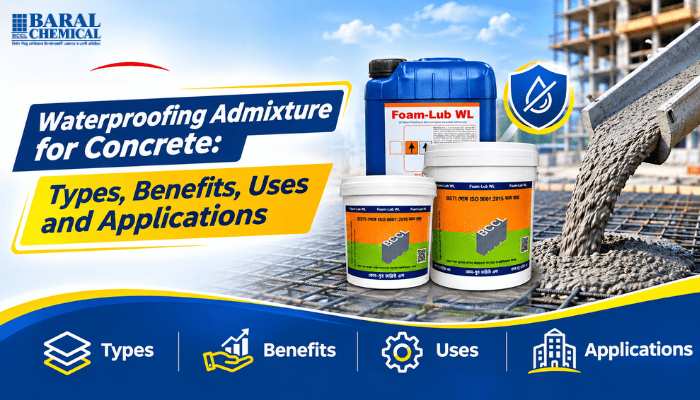
Water can enter concrete through pores, cracks, and poorly sealed joints. Over time, moisture may damage surfaces and increase the risk of reinforcement corrosion.
As a result, buildings need suitable protection against water penetration.
A waterproofing admixture for concrete helps improve water resistance from within the concrete mix. Unlike surface coatings, workers add this chemical directly to concrete or cement mortar during mixing.
However, the chemical alone cannot prevent every type of leakage. Proper mixing, placement, compaction, and curing also matter.
In this guide, you will learn about waterproofing admixtures, their benefits, types, and uses. You will also learn how Foam-Lub WL from Baral Chemical Company Ltd. supports concrete waterproofing requirements.
What Is a Waterproofing Admixture for Concrete?
A waterproofing admixture for concrete is a chemical that improves concrete’s resistance to water penetration.
Workers add it during mixing. So, the admixture becomes part of the concrete instead of forming a separate surface layer.
Different admixtures work in different ways. For example, some reduce water absorption, while others help limit water movement through the concrete.
Engineers often consider these products for basements, water tanks, swimming pools, and similar structures.
However, the concrete must also meet the project’s mix design and waterproofing requirements.
How Does a Waterproofing Admixture Work?

Concrete contains small pores and internal spaces. Water can move through connected pores, cracks, and construction defects.
A waterproofing admixture helps reduce water movement through suitable concrete.
However, its working method depends on the product formulation.
Some admixtures reduce capillary water absorption. Others react within the cementitious material to improve water resistance.
For example, Baral Chemical describes Foam-Lub WL as an admixture that reacts with cement paste. This process helps improve concrete impermeability.
Still, the results depend on the concrete mix, dosage, and application conditions.
Why Is Concrete Porosity Important?
Concrete naturally contains pores. However, excessive mixing water can increase connected pores after hardening.
Poor compaction can also create unwanted voids.
As a result, water may find more pathways through the concrete.
A suitable mix design helps control these problems. In addition, waterproofing admixtures can support water resistance when workers apply them correctly.
Types of Waterproofing Admixtures for Concrete
Different waterproofing admixtures serve different construction needs.
Therefore, engineers should understand their functions before choosing a product.
1. Hydrophobic Waterproofing Admixtures
Hydrophobic admixtures help reduce capillary water absorption.
These chemicals make suitable cementitious materials less likely to absorb water through their pores.
As a result, they can support moisture protection in appropriate applications.
However, engineers must verify whether a specific product suits continuous water pressure.
2. Crystalline Waterproofing Admixtures
Crystalline admixtures contain ingredients that react inside concrete.
These reactions can form products that reduce water movement through suitable capillary pathways.
For this reason, engineers may consider crystalline admixtures for underground and water-exposed structures.
However, their actual performance depends on the formulation and concrete conditions.
3. Multifunctional Waterproofing Admixtures
Some waterproofing admixtures offer more than water resistance.
For example, certain formulations also support concrete workability, flowability, or compaction.
Baral Chemical’s Foam-Lub WL is a waterproofing and anti-corrosive concrete admixture.
According to its Technical Data Sheet, the product supports water resistance and selected concrete performance properties.
Therefore, engineers can evaluate it for projects requiring waterproofing and concrete protection.
Why Is Waterproofing Admixture Important in Bangladesh?
Bangladesh receives heavy rainfall during the monsoon season. As a result, many concrete structures face regular moisture exposure.
Basements may experience groundwater pressure. Meanwhile, water tanks and reservoirs must retain water.
Bridges, culverts, and treatment plants also face demanding exposure conditions.
For these reasons, proper concrete waterproofing is important in many construction projects.
Basement Waterproofing
Basements can face moisture and groundwater pressure.
Water may enter through pores, cracks, or construction joints.
A suitable waterproofing admixture can help improve concrete water resistance.
However, engineers must also consider drainage, joint treatment, and external water pressure.
Water Tank Waterproofing
Water tanks need concrete that can retain water.
Poor compaction and damaged joints may cause leakage.
Therefore, engineers should combine a suitable concrete mix with proper waterproofing details.
A waterproofing admixture can support this process.
Infrastructure Protection
Bridges, culverts, and water treatment structures often face moisture exposure.
Over time, unwanted water penetration may contribute to deterioration.
A suitable concrete waterproofing system can help manage these risks.
Main Benefits of Waterproofing Admixture for Concrete
A suitable waterproofing admixture can support concrete performance in several ways.
However, the actual benefits depend on the product, mix design, and application.
1. Better Water Resistance
Waterproofing admixtures help reduce water movement through suitable concrete.
As a result, they can support protection in moisture-exposed structures.
2. Improved Concrete Durability
Moisture can contribute to concrete deterioration.
Therefore, reducing unwanted water penetration may support long-term durability.
However, the complete concrete design still determines overall performance.
3. Better Workability
Some multifunctional admixtures improve concrete flowability.
For example, Foam-Lub WL lists workability and flowability among its intended benefits.
This can help workers place concrete more effectively when they use a suitable mix.
4. Support for Concrete Compaction
Good compaction helps reduce voids and honeycombing.
Certain admixtures improve concrete handling and flow.
However, they cannot replace proper vibration and compaction practices.
5. Corrosion-Related Protection
Water penetration can contribute to conditions that promote reinforcement corrosion.
Foam-Lub WL is designed to support waterproofing and anti-corrosive protection.
Still, proper concrete cover, crack control, and construction practices remain important.
Where Can Waterproofing Admixture Be Used?
Engineers use waterproofing admixtures in different water-exposed concrete structures.
However, each project has different performance requirements.
| Application | Main Requirement |
|---|---|
| Basements | Resistance to groundwater penetration |
| Water Tanks | Water-retaining concrete |
| Swimming Pools | Protection against water leakage |
| Reservoirs | Water resistance |
| Bridges | Moisture-related concrete protection |
| Culverts | Water exposure resistance |
| ETP Structures | Water resistance and project-specific chemical protection |
| WTP Structures | Suitable water-retaining concrete |
| Dams | Water-resisting concrete systems |
For example, a swimming pool needs water-retaining concrete. Meanwhile, an effluent treatment plant may also require chemical resistance.
Therefore, engineers should select the product according to the project specifications.
Foam-Lub WL: Waterproofing Admixture from Baral Chemical

Foam-Lub WL is a ready-to-use, chloride-free waterproofing and anti-corrosive concrete admixture.
Baral Chemical Company Ltd. manufactures the product for suitable concrete and cement mortar applications.
According to its TDS, Foam-Lub WL helps improve concrete impermeability. It also supports workability, flowability, and compaction.
As a result, contractors can consider it for several water-exposed construction projects.
Key Benefits of Foam-Lub WL
Baral Chemical lists the following benefits in its product documentation:
- Improved waterproofing performance
- Better concrete workability
- Improved flowability
- Anti-corrosive protection
- Salinity-related protection
- Support for effective compaction
- Reduced permeability and unwanted voids
However, project results may vary. Therefore, engineers should confirm performance through suitable mix design and testing.
Technical Properties of Foam-Lub WL
The following specifications come from Baral Chemical’s Technical Data Sheet.
| Technical Property | Specification |
|---|---|
| Product Type | Waterproofing and Anti-Corrosive Concrete Admixture |
| Appearance | Light Yellow Liquid |
| Form | Ready-to-Use Liquid |
| Specific Gravity | 1.07 ± 0.01 at 20°C |
| pH Value | 7 ± 1 |
| Chloride Content | 0.0% as Stated in TDS |
| Recommended Dosage Range | 0.5–4% by Weight of Cement |
| Packaging | 20 L, 200 L and Bulk Supply |
| Shelf Life | Minimum 2 Years Under Specified Storage Conditions |
The TDS also lists ASTM C494 Type A, ASTM C231, BS EN 934-2, and BS 1881-122.
These are manufacturer-declared details. Therefore, projects requiring formal compliance evidence should request supporting test documents.
Recommended Dosage of Foam-Lub WL
Baral Chemical recommends a general dosage range of 0.5–4% by weight of cement.
However, this range does not represent a fixed dosage for every project.
Different cement types, aggregates, and site conditions can affect performance.
Therefore, engineers should conduct trial mixes before selecting the final dosage.
Applications of Foam-Lub WL
According to Baral Chemical’s TDS, Foam-Lub WL is intended for:
- Basements
- Water tanks
- Swimming pools
- Reservoirs
- Bridges
- Culverts
- Effluent Treatment Plants (ETP)
- Water Treatment Plants (WTP)
- Dam concrete
Each application requires suitable concrete design and construction practices.
Product Details: Foam-Lub WL – Waterproofing Concrete Admixture
Waterproofing Admixture vs. Waterproofing Coating
Both products help reduce water penetration.
However, they work in different ways.
| Feature | Waterproofing Admixture | Waterproofing Coating |
|---|---|---|
| Application | Added during mixing | Applied to a surface |
| Main Function | Improves water resistance within concrete | Creates a protective surface layer |
| Application Stage | Concrete or mortar mixing | New construction or suitable repair |
| Key Requirement | Proper mix design | Proper surface preparation |
| Joint Treatment | May require separate treatment | May require additional detailing |
| Baral Chemical Product | Foam-Lub WL | ConSeal WS2 |
For example, workers add Foam-Lub WL during concrete mixing.
In contrast, they apply ConSeal WS2 to suitable prepared surfaces.
Therefore, the products serve different waterproofing requirements.
Some projects may need both integral waterproofing and surface protection.
How to Choose the Right Waterproofing Admixture for Concrete
Choosing the right product requires careful evaluation.
Follow these steps before purchasing.
Step 1: Identify Water Exposure
First, determine how the structure will contact water.
Does it face occasional moisture, continuous water exposure, or groundwater pressure?
This helps define the required waterproofing performance.
Step 2: Review the Concrete Mix
Next, check the cement type, aggregates, water content, and required strength.
The admixture must work with the approved concrete mix.
Step 3: Check the Technical Data Sheet
Review the product’s applications, dosage guidance, and limitations.
Also, check the available technical test information.
Step 4: Conduct Trial Mixes
Trial mixes help engineers evaluate compatibility and performance.
Baral Chemical also recommends trials for Foam-Lub WL.
Therefore, confirm the dosage before full-scale concrete placement.
Step 5: Plan Joint Protection
Water can enter through poorly treated construction joints and cracks.
So, include suitable joint treatment and crack control in the waterproofing plan.
Step 6: Follow Proper Construction Practices
Finally, maintain proper mixing, placement, compaction, and curing.
Even a suitable admixture cannot replace good construction practices.
Common Mistakes When Using Waterproofing Admixtures
Incorrect product use may affect concrete performance.
Therefore, avoid these common mistakes.
- Using too much admixture: Higher dosage does not always improve waterproofing. Follow trial-mix results and technical guidance.
- Adding extra water: Uncontrolled water addition may increase permeability and affect strength.
- Skipping compatibility tests: Different cement and aggregate combinations can change product performance.
- Ignoring construction joints: Waterproofing admixtures cannot automatically seal every joint or crack.
- Poor compaction: Inadequate vibration can leave voids and honeycombing.
- Improper curing: Concrete needs suitable curing conditions to develop its intended properties.
Following the approved construction method helps reduce these risks.
Choosing a Waterproofing Admixture Supplier in Bangladesh
Choosing the right supplier is important for concrete waterproofing projects.
First, check the manufacturer’s product documentation.
Next, compare the recommended applications, technical properties, and available support.
Also, confirm whether the product meets the actual project requirements.
Baral Chemical Company Ltd. is a construction chemical manufacturer in Bangladesh.
The company offers concrete admixtures, waterproofing products, and other construction chemical solutions.
Its Foam-Lub WL product is intended for waterproofing and anti-corrosive concrete applications.
For this reason, contractors can contact Baral Chemical to discuss suitable applications and technical requirements.
Frequently Asked Questions
1. What is a waterproofing admixture for concrete?
A waterproofing admixture improves concrete’s resistance to water penetration.
Workers add it during mixing. Therefore, it becomes part of the concrete rather than forming a surface coating.
2. Which concrete waterproofing admixture is available in Bangladesh?
Baral Chemical offers Foam-Lub WL.
It is a chloride-free waterproofing and anti-corrosive concrete admixture for suitable construction applications.
3. What is the recommended dosage of Foam-Lub WL?
The TDS provides a dosage range of 0.5–4% by weight of cement.
However, engineers must determine the final dosage through trial mixes.
4. Can waterproofing admixture stop all concrete leakage?
No. Cracks, construction joints, and concrete defects may still allow water to enter.
Therefore, proper detailing and construction practices remain necessary.
5. Can waterproofing admixture be used in water tanks?
Yes, suitable waterproofing admixtures can support water-retaining concrete.
Foam-Lub WL lists water tanks and reservoirs among its applications. However, potable water use requires confirmation of relevant water-contact requirements.
6. Is waterproofing admixture better than waterproofing coating?
Neither product is automatically better.
Admixtures work within concrete, while coatings protect suitable surfaces. Therefore, the correct choice depends on the project.
Choose the Right Waterproofing Admixture for Your Project
A waterproofing admixture for concrete can help improve water resistance and support concrete protection.
It may suit basements, water tanks, swimming pools, reservoirs, and other water-exposed structures.
However, successful waterproofing also requires proper mix design, compaction, curing, and joint treatment.
Baral Chemical Company Ltd. offers Foam-Lub WL for suitable waterproofing and anti-corrosive concrete applications.
Before using the product, review its TDS and confirm the dosage through trial mixes.