
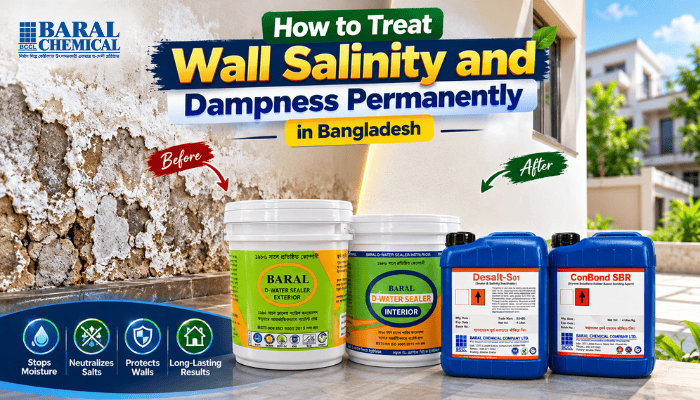
Wall salinity and dampness are among the most persistent structural issues affecting residential and commercial buildings across Bangladesh. The telltale signs—bubbling paint, chalky white deposits, damp odors, and decaying plaster—often appear shortly after construction or during the wet monsoon season.
Many property owners repeatedly repaint affected surfaces only to find the salt deposits rupturing the paint film within months. Treating wall salinity permanently requires addressing the chemical mechanism behind efflorescence rather than masking the surface. Partnering with a reliable chemical company ensures that the root cause—subsurface moisture and active soluble salts—is neutralized at the substrate level.
What Causes Wall Salinity and Dampness in Bangladesh Buildings?
In local construction, masonry units, plaster mortar, and concrete are frequently exposed to environmental moisture and mineral salts. Understanding the exact origins of salinity is key to implementing an effective, long-term repair:
Subsoil Moisture and Capillary Action: High water tables allow ground moisture to rise through foundation brickwork via capillary action (rising damp), transporting dissolved salts upward into ground-floor walls.
Unwashed River Sand and Low-Grade Aggregates: Sand sourced from saline rivers or unwashed clay-heavy aggregates contains inherent sodium and magnesium salts that activate as moisture evaporates.
Severe Monsoon Exposure and Atmospheric Humidity: Prolonged rains saturate porous exterior plaster, dissolving internal mineral salts that crystallize on surface walls as the structure dries out.
Inadequate Structural Waterproofing: Failure to apply damp-proof course (DPC) barriers or integral admixtures during base construction leaves masonry vulnerable to ongoing moisture ingress.
Why Traditional Paint and Surface Patching Fail
When moisture migrates through brick masonry, it dissolves salts trapped within the matrix. As water evaporates at the wall surface, the salts crystallize, expand, and exert extreme sub-surface pressure—a process known as efflorescence or saltpeter (লোনা/নোনা) action.
Standard putty and acrylic paints form a thin, non-breathable skin over damp plaster. Trapped moisture and expanding salt crystals exert pressure behind this film, leading to delamination, peeling, and crumbling plaster. Achieving a permanent solution requires a chemical intervention that stops the chemical action of the salt itself: a specialized salinity in-activator. When dealing with aggressive moisture and salt crystallization, consulting an experienced construction chemical company is essential to diagnose whether the source is rising damp or atmospheric porosity.
Step-by-Step Guide for Brick and Plaster Wall Salinity Treatment
A permanent anti-salinity treatment requires methodical surface preparation and the systematic application of specialized neutralizing chemicals:
1. Surface Preparation and Stripping
Scrape off all damaged paint, efflorescence deposits, and deteriorated plaster down to the bare brickwork or sound substrate.
Scrub the exposed surface thoroughly with a stiff wire brush to dislodge crystallized salts from pores.
Wash the wall thoroughly with clean, fresh water and allow it to dry to an open, porous state.
2. Deep Chemical Neutralization (Salinity In-Activation)
Apply a deep-penetrating chemical neutralizer such as Desalt-S01 to transform active soluble salts into stable, insoluble compounds.
Application on Exposed Bricks: Dilute Desalt-S01 with clean water and catalyst according to the recommended ratio (1 Liter Desalt-S01 + 10 Liters water + 25 ml catalyst) and saturate the masonry joints and brick faces thoroughly.
Application on Plastered Surfaces: Use the specified plaster dilution (1 Liter Desalt-S01 + 8 Liters water + 25 ml catalyst) to ensure the liquid penetrates hairline pores across the plaster matrix.
Allow the treated surface to cure completely, ensuring the chemical reaction fully stabilizes internal salts.
3. Application of Protective Acrylic Barrier
Once neutralized, seal the exterior-facing masonry against atmospheric moisture and fungal growth using an acrylic polymer sealant like D-Water Sealer.
Apply two coats by roller (2 parts sealer + 1 part water) or brush (3 parts sealer + 1 part water) to establish an elastic, water-repellent barrier that permits vapor breathability while blocking exterior moisture penetration.
Key Anti-Salinity & Damp-Proofing Solutions
Selecting tested formulations developed specifically for regional climatic conditions ensures long-term performance:
| Product Name | Primary Function | Application Ratio & Surface |
Desalt-S01 | Salinity In-Activator & Neutralizer | Brick: 1L Desalt + 10L water + 25ml catalyst
Plaster: 1L Desalt + 8L water + 25ml catalyst |
D-Water Sealer | Acrylic Polymer Anti-Fungal Sealer | Roller: 2 parts sealer + 1 part water
Brush: 3 parts sealer + 1 part water |
Foam-Lub WL | Integral Waterproofing Liquid | Concrete: 200–400 ml per 50 kg cement bag
Plaster: 250–500 ml per 50 kg cement bag |
ConBond SBR | Polymer Bonding & Anti-Damp Agent | Primer Coat: 1 part ConBond SBR + 4 parts water + 7 parts cement |
Preventive Measures for New Construction
Preventing wall salinity before construction begins is far more cost-effective than remediating mature masonry. Sourcing materials from a verified chemical company in bangladesh guarantees certified concrete additives that prevent water permeability right from the casting stage:
Incorporate Waterproofing Admixtures: Blend Foam-Lub WL into masonry mortar and plaster to densify capillary pores, blocking moisture suction from the ground up.
Install Impermeable DPC Barriers: Lay a robust damp-proof course at plinth level using polymer-modified cement slurries modified with ConBond SBR.
Use Clean, Tested Aggregate: Ensure fine and coarse aggregates are rigorously washed to remove silt and trace salts before mix production.
Why Choose Baral Chemical for Salinity and Damp Protection?
When seeking the best chemical company in bangladesh for building preservation, local manufacturing experience and proven chemical engineering matter most. Baral Chemical Company Ltd. stands out as a pioneering Best Construction Chemical Company with a legacy spanning since 1986.
Patented Formulation: Backed by an international patent under the Paris Convention (1995) for anti-salinity technology, offering tested permanence rather than temporary coats.
Quality Certification: Accredited with ISO 9001:2015 quality standards for consistent performance.
Local Technical Support: For property owners and contractors looking for the best chemical company in dhaka, expert site evaluation and on-ground diagnostic assistance are readily available.
Frequently Asked Questions (FAQ)
Can repainting fix wall salinity and peeling plaster?
No. Standard decorative paint merely covers the surface. Without neutralizing the active salt crystals inside the masonry, rising moisture will push the paint film off the wall within months.
What is the role of a salinity in-activator?
A salinity in-activator, such as Desalt-S01, penetrates deep into the porous substrate to react chemically with soluble mineral salts, converting them into inert compounds that cannot crystallize or damage structural plaster.
Which is the most reliable Chemical company in dhaka for damp and salinity advice?
Engineers, contractors, and homeowners can consult Baral Chemical Company Ltd. at their corporate office in Sector-9, Uttara. Recognized as a trusted local chemical company, their technical team provides project-specific application guidance and material testing.