
A small damp patch on the ceiling may not seem serious at first. But after several weeks of rain, that same area can develop peeling paint, water stains, and damaged plaster.
Roof leakage is a common concern for homeowners and building owners in Bangladesh. Heavy seasonal rainfall, poor drainage, surface cracks, and weak waterproofing details can allow water to enter the building.
Choosing the Best Waterproofing Chemical for Roof in Bangladesh starts with understanding the actual problem.
A waterproofing chemical helps protect suitable roof surfaces or concrete systems against water penetration. However, no single product works for every roof. An exposed concrete roof may need a flexible protective coating, while a newly cast slab may benefit from a suitable waterproofing admixture.
This guide explains the main roof waterproofing chemicals, their benefits, applications, and selection methods. It also introduces relevant roof protection products from Baral Chemical Company Ltd.
What Is a Roof Waterproofing Chemical?
A Roof Waterproofing Chemical is a material designed to reduce water penetration through a suitable roof surface or concrete system.
Some products form a protective barrier over the roof. Others are mixed into concrete or mortar during construction.
For example, a liquid waterproofing membrane can form a continuous coating over a prepared roof surface. A cementitious waterproofing product creates a protective layer on compatible concrete, while an integral admixture supports water resistance within a concrete mix.
These methods work differently. Therefore, choosing the right one depends on roof condition, exposure, and construction requirements.
Why Do Roofs Leak in Bangladesh?
Roof leakage may result from several construction and maintenance problems.
Before choosing a waterproofing chemical, identify where the water enters.
1. Cracks in Roof Concrete
Small cracks may develop because of shrinkage, movement, or other construction conditions.
Water can enter through these openings during rainfall.
A waterproofing coating may help protect suitable minor cracks, but structural or moving cracks need proper assessment and repair.
2. Poor Roof Drainage
Standing water increases the time a roof remains exposed to moisture.
If rainwater cannot reach the drainage outlets, it may collect around low areas.
Waterproofing alone cannot correct an unsuitable roof slope. Drainage problems should be addressed as part of the treatment.
3. Weak Waterproofing Around Joints
Water often enters through construction joints, parapet connections, and pipe penetrations.
These areas need careful waterproofing details.
Simply coating the flat roof surface may leave the main leakage path untreated.
4. Damaged Existing Waterproofing
Older roof coatings may develop cracks, lose adhesion, or become damaged.
Before applying a new product, contractors should inspect the existing layer and confirm whether it can remain in place.
5. Poor Application Practices
Even a suitable product may fail when workers ignore surface preparation, mixing instructions, or curing requirements.
For this reason, application quality matters as much as product selection.
Types of Roof Waterproofing Chemicals in Bangladesh
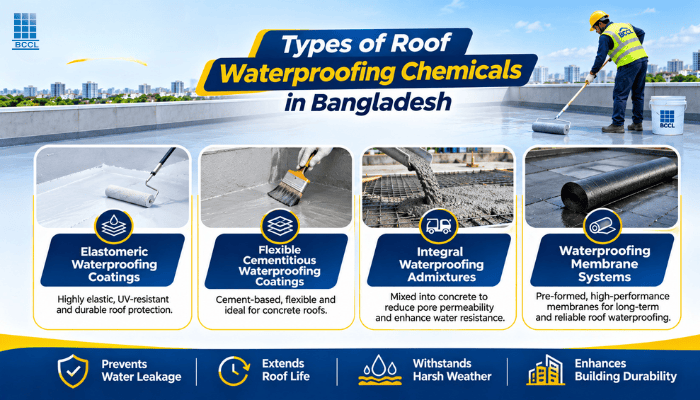
Roof waterproofing products are available in several categories.
Each type offers different advantages and serves different construction conditions.
1. Elastomeric Waterproofing Coatings
Elastomeric coatings form flexible protective layers over suitable roof surfaces.
They can accommodate some movement associated with temperature changes and may help protect against water penetration.
A suitable roof-rated elastomeric coating can be considered for exposed concrete roofs and terraces.
Main Benefits:
- Flexible surface protection
- Continuous coating over compatible substrates
- Resistance to rain exposure when correctly installed
- Ability to accommodate limited surface movement
- Protection against weather-related deterioration
Baral Chemical Product: Con-TopSeal
Con-TopSeal is a single-component, high-elastomeric acrylic waterproofing and heat-insulating membrane.
According to Baral Chemical’s product information, it is developed for roofs, terraces, exterior walls, and other suitable exposed construction surfaces.
The product forms a flexible protective coating intended to resist water penetration, UV exposure, and thermal movement.
Product Information: https://www.baralchemical.com/product/con-topseal/
2. Flexible Cementitious Waterproofing Coatings
Flexible cementitious waterproofing products combine cementitious materials with polymer components.
They form a protective coating over compatible concrete or masonry surfaces.
These systems may be useful where a roof requires a cementitious waterproofing layer, particularly when the coating will receive an approved protective finish.
Main Benefits:
- Adhesion to properly prepared concrete
- Flexible waterproofing protection
- Suitability for selected damp substrates
- Protection against moisture penetration
- Compatibility with specified protective finishing systems
Baral Chemical Product: ConSeal WS2
ConSeal WS2 is a two-component, polymer-modified flexible acrylic cementitious waterproofing coating.
Baral Chemical lists roof waterproofing, roof gardens, balconies, bathrooms, and other wet areas among its applications.
The liquid and powder components are mixed to create a coating for suitable concrete and masonry surfaces.
When using ConSeal WS2 on a roof, the contractor should confirm whether the system requires a protective screed, tiles, or another finishing layer.
Product Information: https://www.baralchemical.com/product/conseal-ws2/
3. Integral Waterproofing Admixtures
Integral waterproofing admixtures are incorporated into concrete or cement mortar during mixing.
Unlike a roof coating, they do not form a separate waterproofing membrane on the finished surface.
Instead, they support selected water-resisting properties of the cementitious mix.
These products are particularly relevant during new roof construction or suitable cementitious work.
Main Benefits:
- Incorporated into concrete or mortar
- Supports concrete water resistance
- Suitable for specified roof casting applications
- May provide additional performance benefits depending on the formulation
Baral Chemical Product: Foam-Lub Meta
Foam-Lub Meta is a specialized heat-insulating and waterproofing concrete admixture.
According to Baral Chemical’s product information, it is intended for roofs, top slabs, roof-level concrete water tanks, and selected cementitious applications.
The product is incorporated during mixing and is designed to support both heat-related performance and water resistance.
Foam-Lub Meta may be considered during roof concrete construction. However, it does not replace proper crack control, joint treatment, drainage, and any additional waterproofing system required by the design.
Product Information: https://www.baralchemical.com/product/foam-lub-meta/
4. Waterproofing Membrane Systems
Waterproofing membranes provide a protective barrier over a roof substrate.
Some are supplied as sheets, while others are applied as liquid materials that form a continuous layer after curing.
Depending on the system, membranes may be used on exposed roofs, terraces, or protected roof assemblies.
The selected membrane must match the roof’s exposure, movement, drainage, and finishing requirements.
Before installation, contractors should verify substrate compatibility, joint details, and the manufacturer’s application instructions.
Which Is the Best Waterproofing Solution in Bangladesh?
The Best Waterproofing Solution in Bangladesh depends on the roof’s construction stage and existing condition.
A product that suits a new concrete slab may not be the right choice for an old roof with active leakage.
The following comparison can help narrow the options.
| Roof Condition | Suitable System to Evaluate | Baral Chemical Option |
|---|---|---|
| Exposed concrete roof | Elastomeric waterproofing coating | Con-TopSeal |
| Roof requiring cementitious waterproofing | Flexible cementitious coating | ConSeal WS2 |
| New roof concrete casting | Integral waterproofing admixture | Foam-Lub Meta |
| Roof garden or protected roof assembly | Designed waterproofing membrane or coating system | ConSeal WS2, subject to system design |
| Roof with active leakage and damaged concrete | Repair followed by suitable waterproofing | Depends on the defect and approved system |
| Old roof with failed coating | Surface repair and compatible replacement system | Con-TopSeal or another suitable system after assessment |
This table is a selection guide, not a performance ranking.
The final product should match the roof condition, technical specifications, and required waterproofing method.
Benefits of Using the Right Roof Waterproofing Chemical
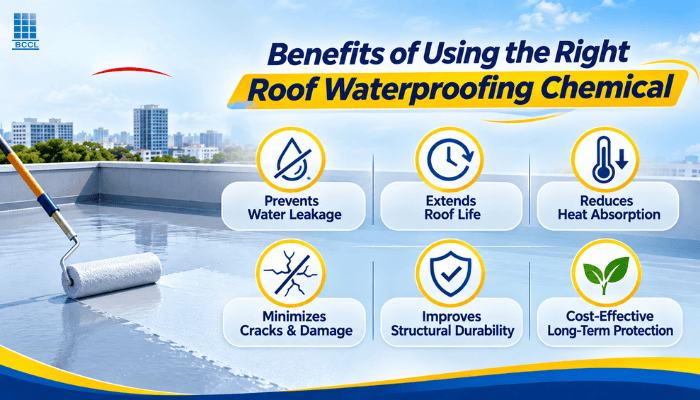
A suitable waterproofing system helps protect a roof against moisture-related problems.
However, the results depend on the product and the quality of installation.
Helps Reduce Water Leakage
Roof waterproofing products create or support barriers against water entry.
When properly applied, they can reduce leakage through the treated areas.
Protects Interior Finishes
Water entering through a roof can damage ceiling paint, plaster, and other interior finishes.
Controlling water penetration helps reduce these moisture-related problems.
Supports Concrete Protection
Water exposure can contribute to deterioration when concrete has cracks, defects, or inadequate protection.
Suitable waterproofing systems help limit moisture entry.
Helps Manage Surface Movement
Some flexible coatings can accommodate limited thermal movement.
This is useful for exposed roofs that experience changes in temperature throughout the day.
May Support Heat-Related Roof Protection
Certain specialized products offer both waterproofing and heat-related functions.
For example, Baral Chemical describes Con-TopSeal as a waterproofing and heat-insulating membrane, while Foam-Lub Meta is designed as a heat-insulating admixture.
Actual thermal performance depends on the complete roof construction and application conditions.
How to Choose a Roof Waterproofing Solution in Bangladesh
Choosing a Roof Waterproofing Solution in Bangladesh requires more than selecting a popular chemical.
Follow these steps before purchasing.
Step 1: Inspect the Roof
Start by checking the roof surface.
Look for cracks, damaged coatings, standing water, blocked drainage outlets, and damp areas below the slab.
The inspection should identify the likely source of water entry.
Step 2: Identify the Construction Stage
Is the roof newly constructed or already in use?
Integral waterproofing admixtures are generally considered during concrete or mortar mixing.
Surface-applied coatings and membranes may be considered for suitable new or existing roof substrates.
Step 3: Check Roof Exposure
An exposed roof faces direct sunlight and rainfall.
A roof covered with tiles, screed, or another protective layer may have different waterproofing requirements.
Choose a system designed for the expected exposure.
Step 4: Review the Technical Data Sheet
Check the product’s intended application, substrate requirements, coverage, mixing instructions, and limitations.
Do not use an estimated dosage or coating thickness without the manufacturer’s guidance.
Step 5: Consider Cracks and Joints
Pay special attention to parapet junctions, pipe penetrations, drains, and construction joints.
These areas may require additional detailing or compatible repair materials.
Step 6: Compare Complete System Costs
Product price alone does not represent the full waterproofing cost.
Also consider surface preparation, crack treatment, coating layers, protective finishes, and application labor.
Step 7: Seek Technical Guidance
A qualified contractor or technical team can help evaluate the roof condition.
For complicated leakage problems, an engineering assessment may be necessary before selecting a waterproofing system.
Roof Waterproofing Application: Key Steps
Application procedures vary by product.
Still, most surface-applied roof waterproofing systems follow a general sequence.
1. Prepare the Surface
Remove loose concrete, dust, grease, dirt, and unsuitable previous coatings.
The surface must meet the selected product’s preparation requirements.
2. Repair Cracks and Damaged Areas
Treat cracks, joints, and damaged concrete using suitable repair methods.
Structural cracks should be assessed before waterproofing work begins.
3. Check the Roof Drainage
Make sure water can move toward the roof outlets.
Correct drainage defects before installing the final waterproofing system.
4. Apply the Required Primer
Some products require a primer, while others have different substrate preparation instructions.
Follow the manufacturer-approved system.
5. Apply the Waterproofing Material
Apply the product according to the Technical Data Sheet.
Maintain the specified mixing ratio, coverage, coating thickness, and waiting time between coats.
6. Allow Proper Curing
Protect the waterproofing material during its required curing period.
Avoid premature water exposure or installation of incompatible finishing materials.
7. Inspect the Completed Work
Check the finished surface, edges, drains, joints, and penetrations.
Where the design and product system permit, conduct the specified waterproofing inspection or water test.
Common Roof Waterproofing Mistakes to Avoid
Waterproofing problems often start before the product is applied.
- Choosing the wrong chemical: A concrete admixture and a surface waterproofing coating have different functions.
- Ignoring drainage: Even a well-applied coating cannot correct a roof that lacks suitable drainage.
- Applying over damaged surfaces: Loose concrete and weak previous coatings can affect adhesion.
- Missing corners and joints: Parapet connections, drains, and pipe penetrations require careful detailing.
- Using incorrect quantities: Too little material or an unsuitable mixing ratio can affect performance.
- Ignoring curing requirements: Early exposure to rain or water may damage an incompletely cured system.
Avoiding these mistakes can help improve the quality of roof waterproofing work.
Roof Waterproofing Products from Baral Chemical Company Ltd.
Baral Chemical Company Ltd. is a Bangladesh-based Construction Chemical Company offering products for waterproofing, concrete admixtures, surface protection, and other building applications.
For roof waterproofing, three products deserve particular attention.
Con-TopSeal — For Exposed Roof Protection
Con-TopSeal is intended for suitable exposed roof surfaces where a flexible acrylic waterproofing membrane is required.
Its formulation is designed to support protection against rainwater, UV exposure, and thermal movement.
Product: https://www.baralchemical.com/product/con-topseal/
ConSeal WS2 — For Flexible Cementitious Waterproofing
ConSeal WS2 is suitable for selected roof waterproofing systems that require a flexible cementitious coating.
The final application should follow its substrate preparation, mixing, coating, and protection requirements.
Product: https://www.baralchemical.com/product/conseal-ws2/
Foam-Lub Meta — For Roof Concrete Applications
Foam-Lub Meta is intended for heat-insulating and waterproofing applications within suitable concrete and cementitious mixes.
It may be considered during roof casting or related roof concrete work.
Product: https://www.baralchemical.com/product/foam-lub-meta/
Customers searching for a Waterproofing Chemical Supplier in Bangladesh can review these products and contact Baral Chemical for project-specific selection guidance.
Frequently Asked Questions
1. What is the best waterproofing chemical for a concrete roof in Bangladesh?
The best product depends on the roof condition. Exposed concrete roofs may need a suitable elastomeric coating, while protected roof systems may use cementitious waterproofing or membranes.
A site inspection helps determine the correct solution.
2. Which Baral Chemical product is suitable for roof waterproofing?
Baral Chemical offers Con-TopSeal, ConSeal WS2, and Foam-Lub Meta for different roof-related applications.
Con-TopSeal is a surface coating, ConSeal WS2 is a flexible cementitious coating, and Foam-Lub Meta is an integral concrete admixture.
3. Can waterproofing chemicals stop roof leakage permanently?
No product can guarantee permanent protection in every situation.
Performance depends on roof condition, drainage, cracks, application quality, maintenance, and the selected waterproofing system.
4. Can I apply waterproofing chemicals to an old roof?
Some surface-applied waterproofing products may suit existing roofs.
However, the contractor must first check cracks, surface damage, old coatings, and drainage problems.
5. What is the difference between Con-TopSeal and Foam-Lub Meta?
Con-TopSeal forms a flexible waterproofing coating over compatible surfaces.
Foam-Lub Meta is added to suitable concrete or mortar mixes during construction.
Their application methods and purposes are different.
6. How do I choose a waterproofing chemical supplier in Bangladesh?
Compare product suitability, Technical Data Sheets, application guidance, availability, and technical support.
Choose a supplier that can explain which system matches your roof requirements.
Choosing the Right Waterproofing Chemical for Your Roof
Roof waterproofing works best when the selected product addresses the actual source of water entry.
Elastomeric coatings protect suitable exposed surfaces. Flexible cementitious coatings serve other waterproofing requirements, while integral admixtures work within concrete or mortar.
The right approach depends on whether the roof is new or existing, its exposure conditions, and the construction details.
Baral Chemical Company Ltd. offers several roof-related waterproofing products, including Con-TopSeal, ConSeal WS2, and Foam-Lub Meta.
Before applying any product, review its technical instructions and confirm compatibility with the roof.